



Engineering the Airborne Targeting Payload: Best LRF Module for UAVs
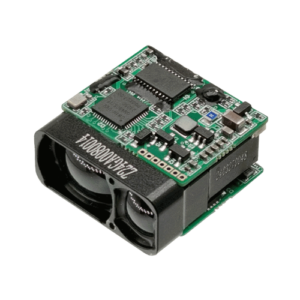
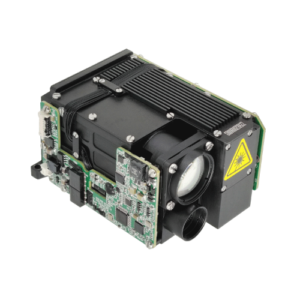
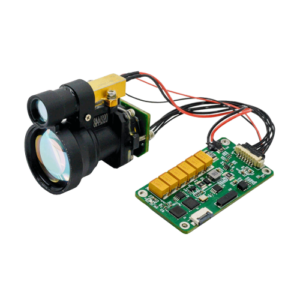
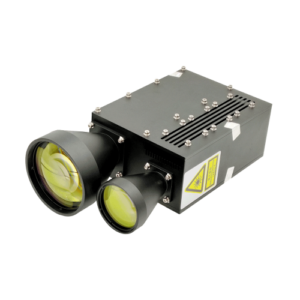
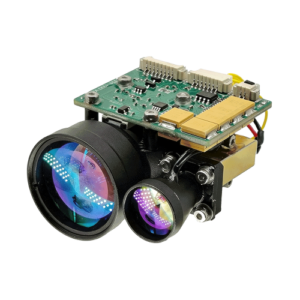
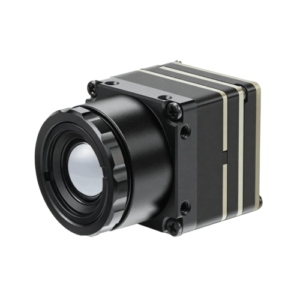
Selecting the best LRF module for UAVs requires balancing optical transmission physics, airborne weight limits, and boresight stability under dynamic gimbal vibration. For tactical electro-optical/infrared (EO/IR) pods, a sub-50 g, 1535 nm erbium-glass laser rangefinder module delivering 3 to 6 km detection on 10% NATO targets represents the operational gold standard. It provides up to 100 times higher eye-safe pulse energy than legacy 905 nm diodes while maintaining optical axis drift below 0.15 mrad across extreme flight conditions.
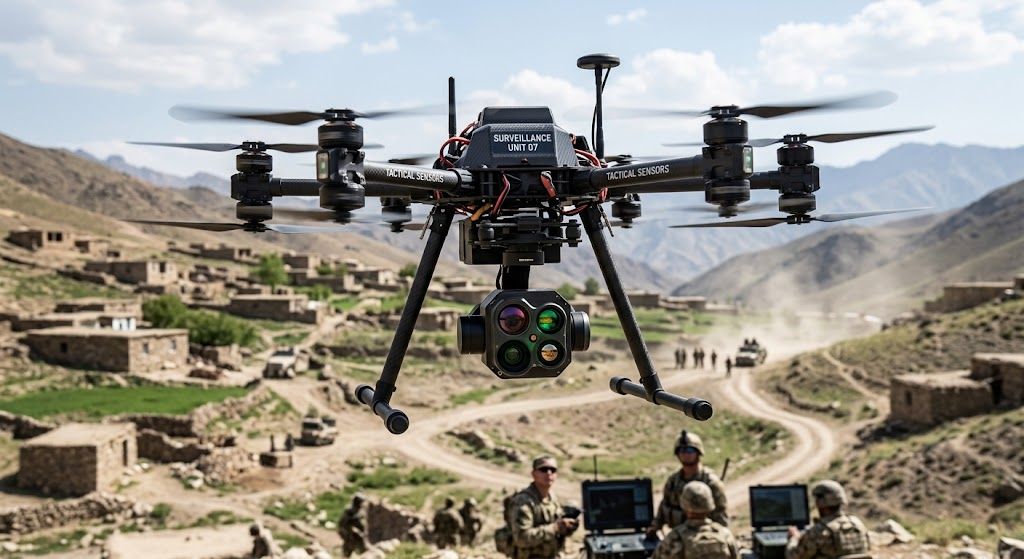
Modern unmanned aerial vehicles demand precise target geolocation without compromising flight endurance. When integrating a drone gimbal laser rangefinder into multi-sensor turrets, systems engineers face strict physical constraints. A minor miscalculation in thermal dissipation, pulse current peaks, or mass distribution can destabilize high-bandwidth brushless gimbal stabilization loops.
In our manufacturing and payload integration experience, ranging dropouts on the flight line rarely stem from software bugs. Instead, they trace back to sub-optimal laser wavelength physics, inadequate structural damping against motor harmonics, or unshielded pulse drivers disrupting sensitive onboard GNSS and RTK avionics.
The Universal UAV-LRF Payload Evaluation Standard (SWaP-O-E Framework)
Rather than evaluating sensors through fragmented datasheets, systems integrators should adopt a unified methodology. We evaluate aerial laser rangefinder integration through the Universal UAV-LRF Payload Evaluation Standard (SWaP-O-E Framework). This engineering protocol grades modules across four interconnected dimensions:
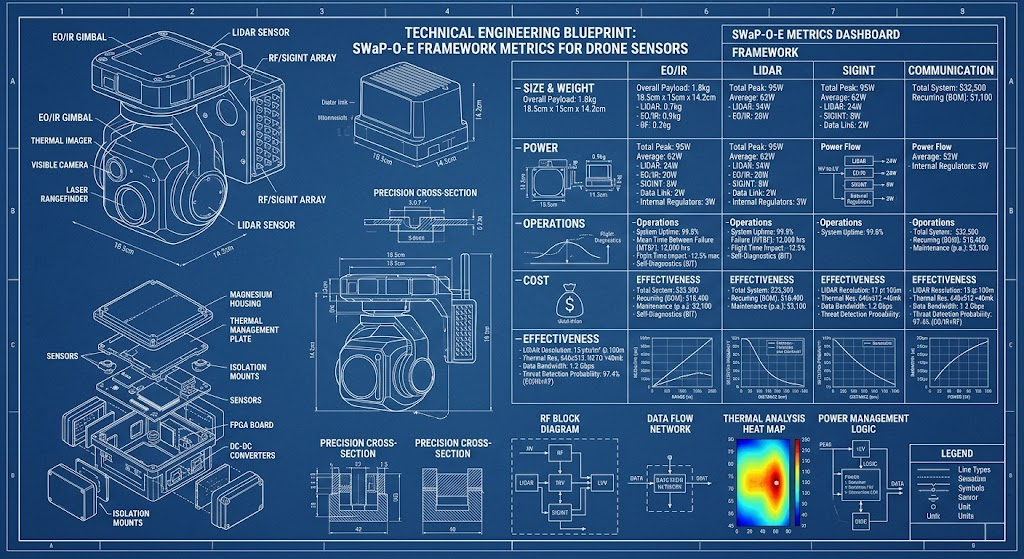
- Size, Weight, and Power-Cost (SWaP-C): Absolute payload mass must remain ≤ 45 g for micro-gimbals (4-inch to 6-inch spheres). Standby power consumption must not exceed 0.8 W, with input current spikes strictly clamped to protect shared avionics batteries.
- Optical Efficiency & Physics: Selection between short-wave near-infrared (905 nm) and eye-safe infrared (1535 nm) based on atmospheric extinction coefficients, photon sensitivity, and Maximum Permissible Exposure (MPE) thresholds.
- Optomechanical Axis Retention: Mechanical integrity ensuring boresight divergence and transceiver alignment drift stay ≤ 0.15 mrad under dynamic vibrational profiles and steep thermal gradients (-40°C to +65°C).
- Electronic & Bus Integration Architecture: Native low-latency signaling (RS-422 or 3.3V TTL UART) capable of handling continuous multi-target echo returns without dropping frame rates or corrupting autopilot telemetry.
| Metric | 905 nm GaAs Diode | 1064 nm Nd:YAG / DPSS | 1535 nm Er:Glass (Stalaser Standard) |
|---|---|---|---|
| Module Mass | 15 – 35 g | 180 – 450 g | 32 – 45 g |
| Standby / Active Power | 0.3 W / 1.5 W | 4.5 W / 25 W (Thermal TEC required) | ≤ 0.5 W / 2.2 W (Passive cooling) |
| 10% NATO Target Range | 600 – 1,200 m | 5,000 – 12,000 m | 3,000 – 6,000 m |
| Ocular Safety Class | Class 1 (Severely restricted power) | Class 3R / Class 4 (Retinal Hazard) | Class 1 Eye-Safe (IEC 60825-1:2014) |
| Boresight Retention (-40°C to +65°C) | > 0.6 mrad (Plastic/Molded housing) | ≤ 0.2 mrad (Machined metal) | ≤ 0.15 mrad (Monolithic Invar bench) |
Wavelength Physics: 905 nm Diode vs. 1535 nm Erbium-Glass
Atmospheric optics dictate operational ranging performance long before the pulse reaches an onboard photodiode. Drone payloads operate in environments with varying levels of aerosols, humidity, smoke, and ambient solar background radiation.
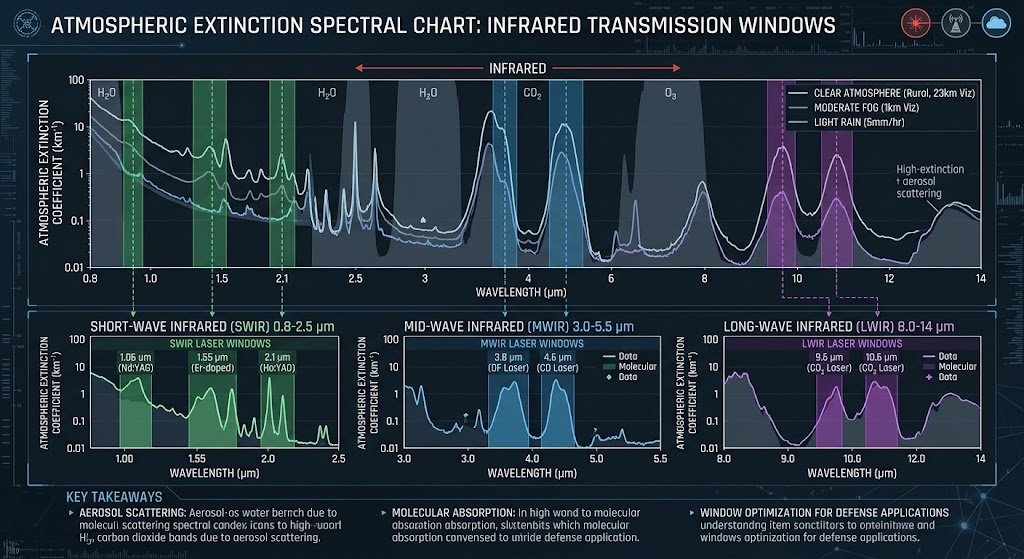
A commodity 905 nm semiconductor laser diode relies on silicon avalanche photodiodes (APDs). While cost-effective, 905 nm radiation falls squarely inside the ocular transmission window. This means the human cornea and lens focus the incident energy directly onto the retina.
Under international standards defined by IEC/EN 60825-1:2014, the Maximum Permissible Exposure for 905 nm is strictly capped. Increasing peak emitter power to penetrate fog or distance breaches Class 1 eye-safe limits. Furthermore, peak solar irradiance at sea level heavily overlaps the 900 nm band (roughly 0.8 W/m²/nm), creating high background noise that obscures weak photon returns from non-cooperative, low-reflectivity objects.
Switching to a 1535nm erbium-glass laser rangefinder resolves this optical bottleneck. Photons emitted at 1535 nm are absorbed within the cornea and the aqueous humor of the human eye before reaching sensitive retinal cells.
Corneal Absorption Physics: The ocular damage threshold at 1535 nm is approximately 4 orders of magnitude higher than that at 905 nm or 1064 nm. Consequently, Class 1 eye-safe compliance permits up to 100 times higher output pulse energy, enabling high-peak-power pulses (e.g., > 30 μJ in sub-5 ns durations) to burn through atmospheric attenuation without endangering personnel.
Solar spectral irradiance drops significantly at 1535 nm (down to ~0.25 W/m²/nm). When combined with an ultra-sensitive InGaAs avalanche photodiode operating in high-gain Geiger or linear mode, the link budget improves substantially. The 1535 nm wavelength penetrates maritime haze, battlefield smoke, and industrial particulate far more effectively than shorter wavelengths, making it the superior choice for tactical aerial reconnaissance.
Optomechanical Hardening: Boresight Retention Under Harmonic Vibration
A laser rangefinder module can feature flawless internal optics and still fail in flight if its structural bench lacks dynamic rigidity. UAV multi-rotor and fixed-wing gimbals generate severe high-frequency mechanical vibration. Motor pole passing frequencies and propeller blade pass disturbances (50 Hz to 2000 Hz) constantly vibrate the payload chassis.
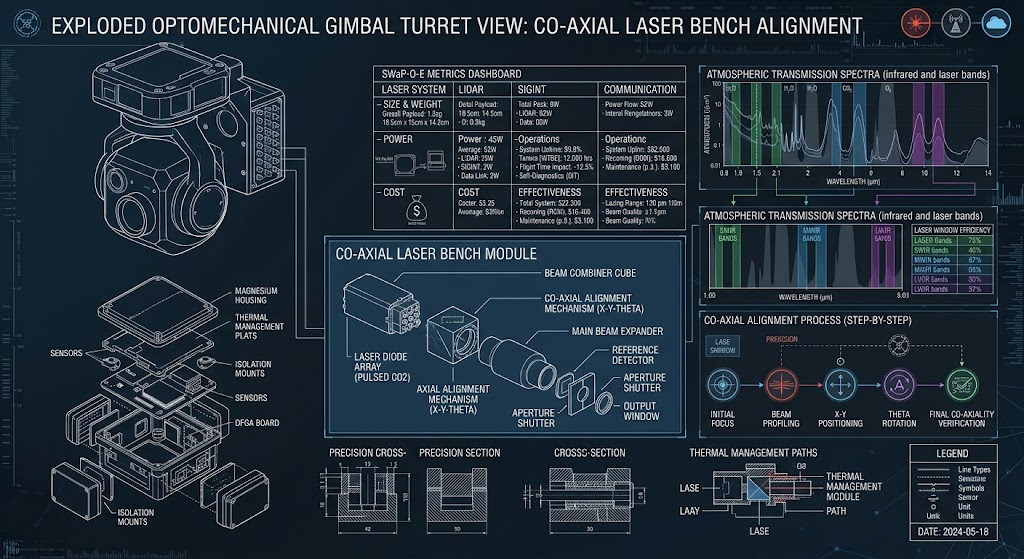
In dual-channel or tri-sensor gimbal architectures combining high-definition daylight CMOS, cooled/uncooled MWIR/LWIR thermal cores, and an LRF, boresight retention is vital. If the laser transmitter beam divergence is 0.5 mrad, an optomechanical housing deflection of just 0.3 mrad displaces the laser footprint completely outside the narrow crosshairs of a thermal imager at 3 km. The operator sees a target on screen, fires the laser, and receives zero return because the pulse misses the target.
Stalaser stabilizes this axis through specialized design principles:
- Monolithic Co-Axial Housings: Transmitter and receiver optical channels are integrated within a single structural housing machined from aerospace-grade aluminum or thermal-matched invar alloys. This design eliminates relative pitch and yaw errors between separate optical barrels.
- Athermal Lens Architecture: Optical elements utilize matching positive and negative thermal expansion coefficients. This holds optical focal lengths stationary from -40°C to +65°C, preventing beam expansion at thermal extremes.
- MIL-STD-810H Shock & Vibration Damping: Modules undergo verification testing against 40g/11ms physical shock pulses and severe 5-500 Hz random vibration profiles to eliminate structural resonance within the gimbal enclosure.
Engineering Insight: In our environmental qualification lab, conventional twin-barrel modules secured with silicone bonding regularly experience boresight drifts of 0.4 to 0.8 mrad during thermal cycling from -20°C to +55°C. Monolithic invar-stabilized optomechanics limit axis shift to ≤ 0.12 mrad across a wider operational span (-40°C to +65°C), keeping the pulse locked to the camera crosshair.
Avionics Interfacing: Serial Protocols, Bus Architecture, and EMI Management
A laser rangefinder serves little purpose if its data link causes communications latency or its switching power supply interferes with flight-critical avionics. Integrating an airborne laser rangefinder module demands strict attention to electrical and firmware interfaces.
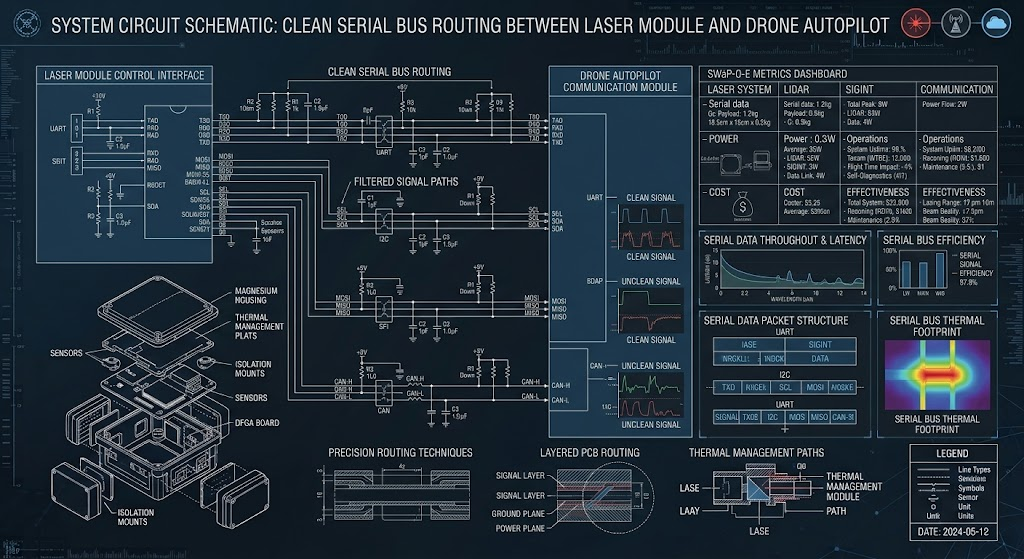
Bus Architectures: RS-422 vs. 3.3V TTL UART
Payload designers must select bus transceivers that balance slip-ring wire count against noise immunity:
- TTL UART (3.3V Logic): Ideal for compact gimbals where the LRF module sits within 15 cm of the primary payload processor board. It minimizes weight by removing transceiver IC overhead, though single-ended signaling remains susceptible to ground bounce from gimbal motor PWM drivers.
- Differential RS-422: The preferred choice when serial signals traverse mechanical slip rings or route along carbon-fiber boom tubes toward a central fuselage processor. Differential signaling rejects common-mode electromagnetic noise and supports long cable runs at baud rates up to 115,200 bps or 921,600 bps without frame errors.
Electromagnetic Compatibility (EMC): Protecting GNSS/RTK
Erbium-glass transmitters fire sub-nanosecond optical pulses using rapid capacitor discharge circuits. Without adequate design precautions, these fast dI/dt events radiate broadband EMI across GPS L1/L2 and RTK frequency bands (1.2 GHz to 1.6 GHz). This interference can trigger satellite lock dropouts during continuous laser firing.
Stalaser modules incorporate internal multi-layer PCB shielding, solid ground planes, and high-suppression LC input filters compliant with MIL-STD-461G standards. These filters attenuate high-frequency switching noise, allowing the rangefinder to operate in close proximity to sensitive GNSS patch antennas.
Flight Controller and Software Stack Integration
Modern defense and industrial drone architectures avoid locked, proprietary software formats. Stalaser OEM modules deploy compact, high-efficiency binary command protocols. They integrate directly into open-source autopilots like ArduPilot and PX4, as well as robotic operating environments using standard ROS2 nodes.
The firmware allows direct software control over critical parameters: setting Pulse Repetition Frequency (PRF from single-shot up to 10 Hz or 20 Hz), setting minimum and maximum range gates to filter out rotor blades or rain clutter, and toggling First-Echo vs. Last-Echo return priority.
The Benchmark: Sub-50g 1535nm Eye-Safe LRF for Long-Range Small UAV Payloads
For mid-sized multi-rotors, tactical VTOLs, and group 1/2 fixed-wing platforms, every gram saved extends loiter time. Small tactical units cannot carry bulky 300 g flash-lamp or legacy DPSS rangefinders. Conversely, consumer-grade 905 nm rangefinders fail when tasked with ranging low-reflectivity vehicles hidden against foliage at extended standoff distances.
This creates an operational demand for a sub-50 g, 1535 nm eye-safe Class 1 rangefinder module capable of acquiring low-reflectivity (10% NATO standard) targets at ranges between 3 km and 6 km.
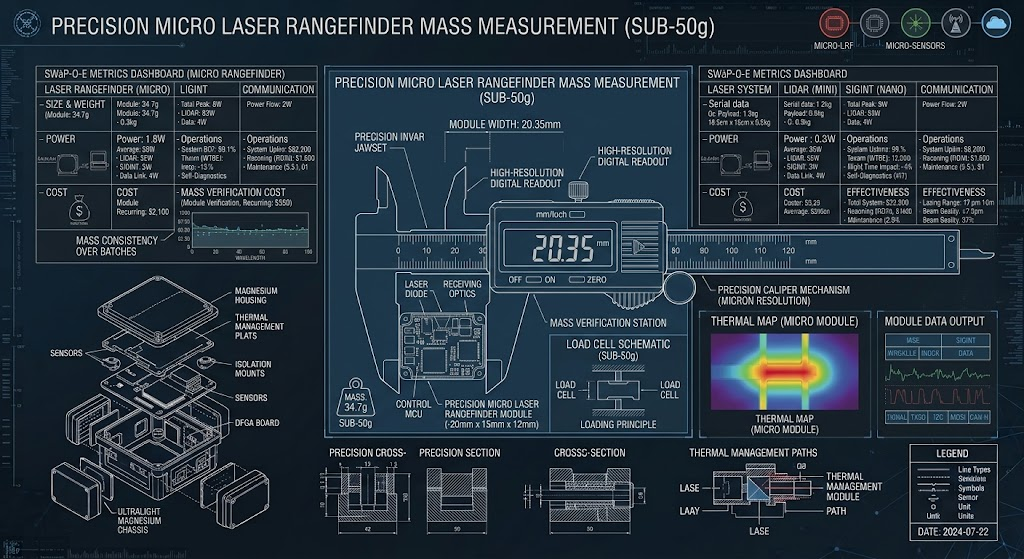
Stalaser engineering bridges this gap by pairing passively Q-switched Er:glass micro-lasers with optimized receiving optics. By optimizing thermal conduction paths directly through the outer structural chassis, the module eliminates active thermoelectric coolers (TECs). The result is continuous ranging capability at a fraction of the thermal and power draw:
- Ultra-Low Mass Profile: Total weight is maintained between 32 g and 45 g, permitting seamless installation into 4-inch, 5-inch, and 7-inch gimbal spheres without requiring custom counterweights.
- High Target Discrimination: Ranging resolution remains within ±1 meter out to maximum range, backed by advanced multi-target separation echo algorithms that isolate military vehicles behind camouflaged foliage or perimeter fences.
- Energy-Efficient Architecture: Standby power stays below 0.8 W, with average active operating consumption remaining under 2.5 W during standard 1 Hz to 5 Hz target designation runs.
Mission Profiles: Matching UAV Rangefinder Specs to Operational Scenarios
Matching rangefinder specifications to the operational envelope ensures systems are neither under-engineered nor needlessly over-specified.
Tactical ISR & Counter-UAS (C-UAS)
Tactical reconnaissance requires covert operation and the ability to detect targets beyond counter-battery or acoustic detection thresholds. Because 1535 nm emissions are invisible to standard night vision devices (NVDs) and image intensifier tubes (which operate in the 400 nm to 900 nm band), tactical platforms can track targets undetected.
For C-UAS applications engaging incoming small drones, high pulse repetition rates (10 Hz to 20 Hz) combined with narrow beam divergence (≤ 0.5 mrad) are vital to track rapid kinematic target movements in real time.
Powerline, Infrastructure, and Asset Surveying
Autonomous inspection drones operating near power distribution corridors require high accuracy and thin-target capture capabilities. Power cables provide weak, curved reflective surfaces that scatter laser energy away from the receiver.
Modules deployed in infrastructure inspection require high photon sensitivity and advanced first-echo processing logic. This configuration isolates small overhead wires from terrain returns below, preventing flight path collisions.
Airborne Search and Rescue (SAR)
Maritime and alpine SAR drones operate through dense cloud layers, maritime humidity, and heavy dust. Incorporating last-echo return processing is critical in these scenarios. It filters out early atmospheric reflections from precipitation or smoke, delivering accurate distance telemetry to isolated lifeboats or ground vehicles.
Verification, Environmental Testing, and Manufacturing Rigor
Stalaser is an optoelectronics and laser technology manufacturer specializing in military- and industrial-grade eye-safe laser rangefinder modules, laser warning receivers, and integrated optoelectronic systems for UAV, defense, and surveying markets.
Every module undergoes strict environmental and performance screening across our ISO 9001:2015 cleanroom production line:
- Ocular Safety Validation: Every production batch undergoes spectroradiometric emission verification to ensure Class 1 eye-safe compliance under IEC/EN 60825-1:2014 standards across all operating temperatures.
- Dynamic Environmental Stress Screening: Units are thermal-cycled inside environmental test chambers (-40°C to +65°C) and subjected to multi-axis random vibration profiles matching MIL-STD-810H standards to verify optomechanical axis stability.
- Optical Link Calibration: Automated collimation benches calibrate beam divergence, receiver field of view (FOV), and signal-to-noise thresholds against calibrated NIST-traceable 10% diffuse reflectivity targets.
- Advanced Signal Processing: Proprietary internal FPGA firmware dynamically applies adaptive multi-threshold echo processing, filtering false alarms from airborne dust, rotor wash, or precipitation.
Frequently Asked Questions (FAQ)
Why choose 1535 nm over 905 nm for a drone gimbal payload?
905 nm semiconductor diodes feature limited optical output power due to ocular safety constraints and suffer from solar background interference and atmospheric attenuation beyond 1 km. 1535 nm light is absorbed in the ocular cornea and lens before reaching the retina, permitting up to 100 times higher pulse energy within Class 1 eye-safe limits. This enables reliable target acquisition at 3 to 10 km, covert operation invisible to NVGs, and improved penetration through smoke and haze, all within modules weighing under 45 grams.
How is Stalaser’s LRF module integrated into ArduPilot or custom flight controllers?
Stalaser provides production-ready C/C++ driver packages and straightforward binary protocol implementations for RS-422 and 3.3V UART interfaces. With native support for range-gating commands, first/last echo selection, and continuous refresh rates from 1 Hz to 20 Hz, integrators can fuse distance telemetry directly into target coordinates or auto-tracking loops without writing custom driver layers.
How does gimbal motor vibration affect LRF boresight accuracy, and how does Stalaser resolve it?
Drone gimbals subject optical payloads to high-frequency harmonic vibration (50 to 2000 Hz) and rapid temperature swings, causing micro-deflection in the transmitter and receiver optical paths (boresight drift). Stalaser addresses this through a monolithic co-axial optomechanical housing, a thermal-matched invar optical bench, and rigid potting techniques. The result is optical axis stability maintained within ≤ 0.15 mrad across -40°C to +65°C, preventing ranging dropouts on small tactical targets.
What is multi-target echo detection, and why is it essential for airborne operations?
When an aerial laser fires through light precipitation, foliage, or window glass, multiple reflections return to the receiver. A single-echo sensor risks latching onto the nearest dust particle or leaf canopy, missing the true target. Stalaser multi-target echo algorithms sample the full reflected waveform, allowing the system to isolate and report intermediate and last returns to accurately locate the vehicle beneath.
Does firing a high-voltage pulsed laser interfere with drone GPS or RTK boards?
Unshielded laser modules can radiate EMI spikes that blind sensitive GNSS receivers during pulsing. Stalaser modules use low-noise power regulation, continuous grounded conductive housings, and internal filtering compliant with MIL-STD-461G. This guarantees zero radio-frequency interference with adjacent GNSS, compass, or flight computer links.
Deploy Precision Rangefinding: 3-Step Integration Support
Integrating an advanced eye-safe laser rangefinder into your next airborne sensor package is straightforward. Accelerate your development cycle using our direct engineering integration framework:
- Step 1: Select Your Operational Profile: Define target distance envelopes, weight constraints, and expected interface formats (Micro-Gimbal, Tactical C-UAS, or Long-Range ISR).
- Step 2: Obtain ICD & 3D CAD Models: Access precise 3D STEP models, mass-properties documentation, and Interface Control Documents (ICD) to verify thermal footprints and mechanical bracket alignments.
- Step 3: Connect with Integration Engineering: Work alongside Stalaser optoelectronic specialists to tune divergence profiles, firmware communication rates, and boresight alignment fixtures for your specific production run.
Integrate Stalaser Precision Rangefinders into Your UAV Gimbal
Speak directly with our senior optical payload specialists for CAD models, interface protocols, or custom optoelectronic engineering support tailored to your mission parameters.