

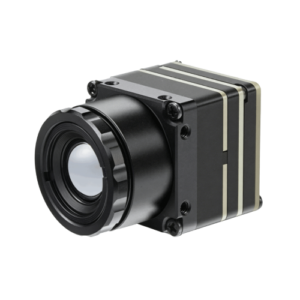
Precision SWaP-C Optoelectronic Architecture
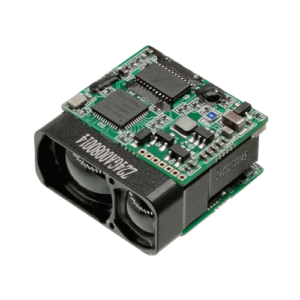
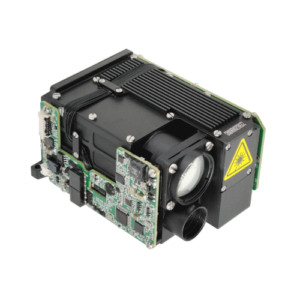
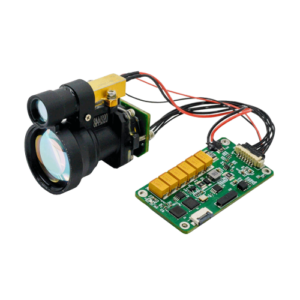
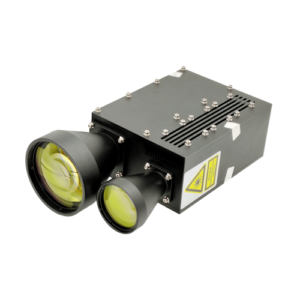
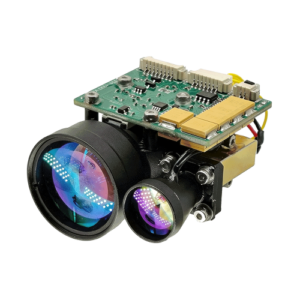
A dependable 3km laser rangefinder module delivers precise time-of-flight telemetry up to 3,000 meters against low-reflectivity targets under variable atmospheric conditions while maintaining strict Class 1 eye-safety compliance. It integrates an optical emitter, receiver, dynamic processing unit, and structural chassis into an ultra-compact payload weighing under 35 grams.
Modern defense, unmanned systems, and thermal targeting optics operate under strict size, weight, power, and cost (laser rangefinder module SWaP-C) constraints. Systems engineers often struggle when standard consumer telemetry units fail against diffuse targets beyond 1,500 meters or when defense-grade solid-state lasers add excessive weight and power draw to micro-gimbals.
Solving this dilemma requires high-efficiency diode-pumped solid-state (DPSS) emitters paired with sensitive InGaAs avalanche photodiodes (APD). This combination provides reliable signal-to-noise ratios (SNR) through rain, dust, and haze without burning up payload battery budgets.
The 3-Tier Evaluation Framework for Long-Range Optoelectronic Payloads
To eliminate ambiguity when specifying laser telemetry hardware, our systems engineering team created the 3-Tier Evaluation Framework for Long-Range Optoelectronic Payloads. This framework moves past optimistic datasheets to evaluate modules under actual field operating conditions.
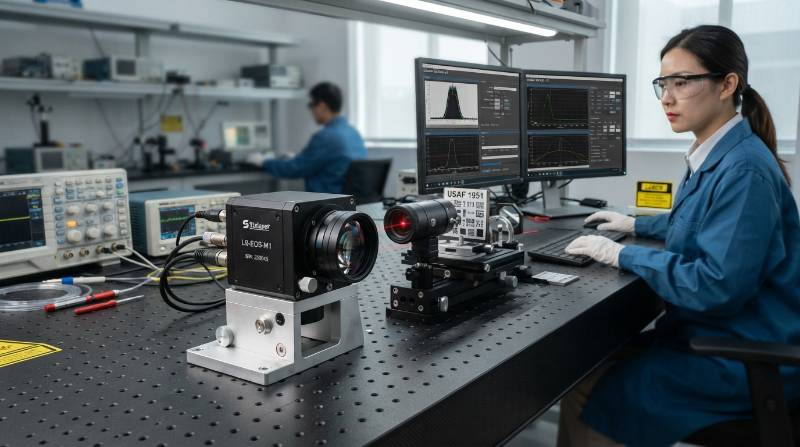
Tier 1: Optical Penetration & Target Albedo Matrix
Published ranges often reference retroreflective tape or high-albedo white targets (reflectivity ρ ≥ 90%). In combat and tactical reconnaissance, real-world targets match standardized NATO vehicle panels (2.3×2.3m, 30% diffuse reflectivity) or camouflaged gear (ρ ≤ 10%). Modules must guarantee minimum detection thresholds at σ ≤ 0.2 km-1 atmospheric extinction.
Tier 2: SWaP-Bore-sight Stability Threshold
A lightweight module is useless if the optical axis shifts during flight or weapon discharge. Modules must retain an optical axis drift ≤ 0.1 mrad across standard operational temperature envelopes (-40°C to +65°C), keeping the measurement beam aligned with narrow-field-of-view thermal sensors.
Tier 3: Wavelength Survivability Index
This index balances atmospheric scattering against human optical safety according to IEC 60825-1:2014 standards. Systems operating at 1535nm provide a Maximum Permissible Exposure (MPE) threshold roughly 10,000 times higher than 905nm diodes. This allows systems to project higher peak energy into adverse weather while maintaining Class 1 ocular safety.
| Evaluation Dimension | Standard Consumer / Industrial LRF | Tactical Grade Specification |
|---|---|---|
| NATO Target Range (30% ρ) | 800m – 1,200m | ≥ 3,000m guaranteed |
| Total Module Mass | 80g – 150g | ≤ 35g (SWaP-optimized) |
| Boresight Thermal Drift | > 0.5 mrad (-20°C to +50°C) | ≤ 0.1 mrad (-40°C to +65°C) |
| Wavelength & Safety | 905nm (Class 1 or 1M restricted) | 1535nm Er:Glass (Class 1 Eye-Safe) |
| Beam Divergence | 1.0 to 2.5 mrad | ≤ 0.5 mrad |
Wavelength Physics: Why 1535nm Er:Glass Outperforms 905nm at 3,000 Meters
Semiconductor gallium arsenide (GaAs) diodes emitting at 905nm dominate entry-level rangefinding due to low component costs. However, they hit a fundamental physics barrier when scaling to tactical 3km ranges.
Light at 905nm penetrates the human cornea directly to the retina, requiring strict emission limits to prevent eye damage. To operate safely without ocular hazards, pulse energies cannot be increased enough to bridge multi-kilometer paths.
When atmospheric extinction reaches σ = 0.2 km-1, a 905nm pulse quickly attenuates below the Noise Equivalent Power (NEP) of standard silicon PIN receivers. The laser simply runs out of energy against low-reflectivity targets.
By contrast, an erbium-glass laser rangefinder operates at 1535nm. This wavelength is absorbed within the ocular cornea and lens, never reaching the retina.
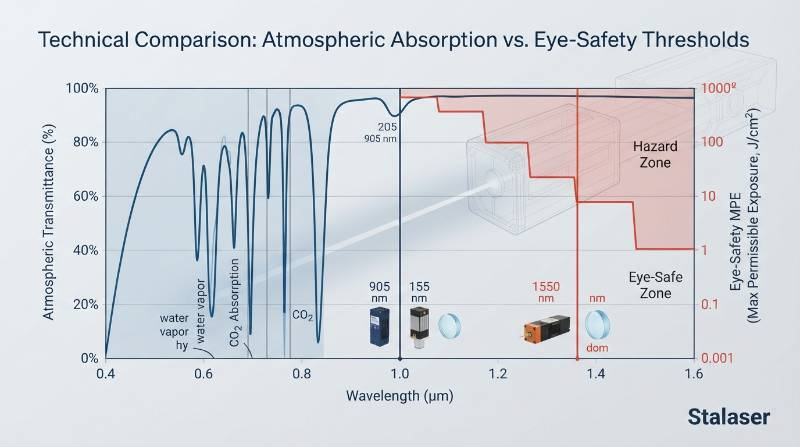
Maximum Permissible Exposure (MPE): Under IEC 60825-1:2014, the human ocular MPE threshold at 1535nm is 1×10⁴ times higher than at 905nm, enabling safe transmission of mega-watt level peak pulse powers in field environments.
Passively Q-switched Er:Glass micro-lasers deliver short pulse durations (under 6 nanoseconds) with peak optical powers exceeding 30kW. This high pulse intensity cuts through haze, aerosol scatter, and humidity, ensuring returns from targets at 3,000 meters and beyond.
Technical Benchmarks & Electro-Optical Link Budget Modeling
Predictable ranging performance relies on the optoelectronic link budget. We calculate received peak optical power (Pr) using the classic radar range equation for Lambertian diffuse targets:
Pr = [ Pt · τt · τr · ηatm2 · ρ · Ar ] / [ π · R2 ]
Where:
- Pt: Transmitter peak power (typically ≥ 30 kW)
- τt, τr: Optical transmission efficiencies of emitter and receiver optics
- ηatm: Atmospheric transmission factor over distance R: exp(-σ · R)
- ρ: Target diffuse reflectivity (ρ = 0.30 for standard NATO hulls)
- Ar: Clear aperture area of the receiver collection optics
- R: Target distance (3,000 meters)
Narrow optical beam divergence (≤ 0.5 mrad) concentrates energy on target. At 3km, a 0.5 mrad beam produces a 1.5-meter diameter spot, keeping all emitted energy on a standard 2.3m NATO target panel.
Signals are detected using temperature-compensated InGaAs APD sensors. Digital signal processing filters noise and implements multi-echo discrimination, letting systems isolate real targets from rain, dust, or camouflage netting.
Hardware Integration: Micro-UAV EO/IR Gimbals and Handheld Sights
Integrating a 3km telemetry module into dual-sensor or tri-sensor drone UAV payloads leaves little room for thermal or structural error. Micro-gimbals require modules that weigh next to nothing and maintain exact mechanical fits.
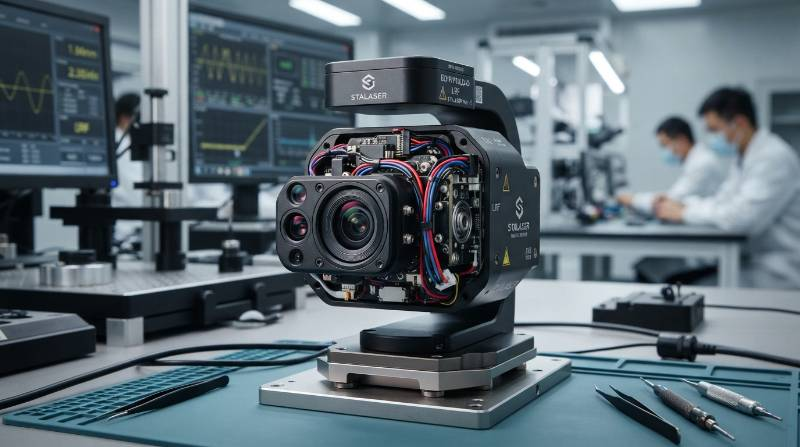
Excess mass increases motor torque demands, draining flight batteries and degrading stabilization. Modules must meet tight mechanical envelopes:
- Total Mass: ≤ 35 grams (including optical assembly and processing electronics).
- Physical Dimensions: Under 48mm × 22mm × 34mm for easy installation beside uncooled long-wave infrared (LWIR) cores.
- Standby Consumption: ≤ 0.2W; active burst ranging consumption ≤ 1.8W.
- Thermal Dissipation: Conductive structural interface paths designed to dump heat into the gimbal yoke without warping optical benches.
Thermal stability is equally critical for soldier-portable handheld binoculars. Modules must provide instant first-pulse ranges without warm-up delays across wide operational temperatures.
Protocol Architecture, Serial Interfaces, and Boresight Alignment
Dynamic targeting demands responsive communication. Modules connect using standard 3.3V UART (TTL) or RS422 serial links, running at selectable baud rates from 115,200 to 921,600 bps.
Command latency must stay below 10 milliseconds. At measurement frequencies from 1Hz to 20Hz, modules continuously feed ranges into target-tracking algorithms, calculating geolocation and velocity in real time.
Co-axial boresight alignment remains stable thanks to precision optical references. Machined mounting surfaces allow technicians to align the laser axis with visible and thermal reticles to within ≤ 0.1 mrad using standard optical collimators.
MIL-STD-810H Ruggedization: Vibration Harmonics and Recoil Shock Resistance
Drones and weapon optics encounter severe physical vibration and shock. Drone motor harmonics range from 100Hz to 2,000Hz, while weapon-mounted systems see sudden shock profiles exceeding 500g/1ms during live fire.
Standard glued optics often shift under these conditions, causing beam walk-off that leaves targeting systems blind. To prevent this, our modules use monolithic aviation-grade aluminum chassis with laser-welded optical mounts, backed by proven laser technology solutions.
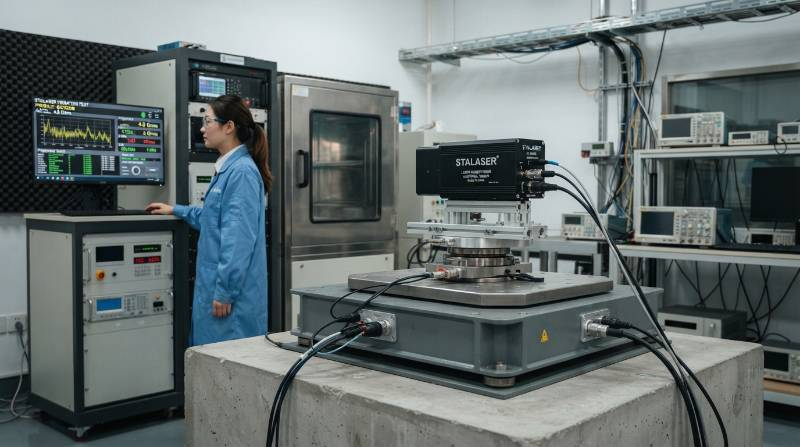
Compliance testing confirms survivability against established operational standards:
- Mechanical Shock: Functional survival through 500g, 1ms half-sine shock pulses along all orthogonal axes (MIL-STD-810H Method 516.8).
- Random Vibration: Continuous exposure to 10Hz–2,000Hz profiles (up to 7.7g RMS) without shifting boresight alignment beyond 0.1 mrad.
- Operating Temperature: Full performance from -40°C to +65°C using dynamic real-time baseline compensation.
- Environmental Sealing: Purged and sealed to IP67 standards to keep moisture off internal optical elements.
Stalaser OEM Manufacturing Standards and Cleanroom Quality Assurance
Stalaser is a premier optoelectronic manufacturer specializing in high-reliability 1535nm eye-safe laser rangefinder modules, laser warning receivers, and integrated laser solutions for defense, aerospace, and industrial measurement systems worldwide.
Consistent optical performance requires strict manufacturing control. All Stalaser production occurs within ISO 9001:2015-certified cleanrooms, preventing airborne particulate contamination on critical optical coatings.
Every single module undergoes traceable quality assurance steps:
- Spectrum and Energy Calibration: Emission profiles are verified to confirm true 1535nm center wavelengths and pulse energies.
- Thermal Chamber Burn-In: Dynamic range verification across -40°C to +65°C temperature transitions.
- Automated Pulse Lifetime Testing: Each unit passes a mandatory >100,000 pulse cycle pre-dispatch burn-in screening.
- Interferometric Boresight Verification: Emission axis and mechanical datum alignments are checked to remain within ≤ 0.1 mrad limits.
3-Step Action Funnel: Specifying Your Custom 3km Laser Module
Integrating a custom laser telemetry solution into your airframe or optronic system follows an established engineering sequence:
- Download Engineering CAD & ICD Interface Docs: Access 3D STEP models, pinout assignments, and UART/RS422 timing tables to verify SWaP fit in your mechanical assembly.
- Request Optical Link Simulation & Evaluation: Provide your target albedo requirements (ρ = 10% to 90%), beam divergence preferences, and weather conditions for custom link budget modeling.
- Sample Acquisition & Engineering Co-Design: Partner with Stalaser optical engineers to adjust mounting flanges, update communication firmware, and take delivery of qualification units.
Frequently Asked Questions (Engineering & Sourcing)
Why does a 905nm module fail to achieve true 3km ranging on real-world military and UAV targets?
At 905nm, semiconductor laser diodes require high pulse peak power to bridge distances above 1,500m. However, because human retinal vulnerability at 905nm is high, output power must be throttled to maintain Class 1 eye safety. Consequently, against non-retroreflective surfaces (such as military vehicles with 30% albedo or dark terrain), 905nm signals drop below the photodiode noise equivalent power (NEP). Stalaser’s 1535nm Er:Glass laser operates in the retina-safe spectral window, allowing higher peak pulse energy without exceeding Class 1 thresholds, ensuring dependable target acquisition at ≥ 3,000m even in haze and light precipitation.
How is boresight co-axial stability maintained under high-vibration drone environments?
Lightweight drone gimbals suffer from high-frequency motor vibration and thermal expansion mismatches. Stalaser modules utilize an integrated single-body aviation alloy chassis with laser-welded cavity optics. This construction guarantees beam divergence of ≤ 0.5 mrad and optical-axis drift of less than 0.1 mrad under MIL-STD-810H vibration and 500g/1ms shock pulses, preventing optical misalignment with paired thermal or visible imaging sensors.
Can the module’s communication protocol and frame rate be customized for proprietary autopilot systems?
Yes. Stalaser provides native TTL-3.3V and RS422 interfaces supporting customizable baud rates up to 921,600 bps. Our engineering team routinely configures data frame structures, measurement frequencies (from single-shot to 20Hz continuous tracking), and dynamic multi-target echo selection modes to match customer autopilots.
Accelerate Your Electro-Optical Payload Program
Meet demanding SWaP constraints without compromising ranging performance. Explore our Class 1 eye-safe 1535nm laser rangefinder modules for your UAV gimbal, handheld thermal binocular, or defense optronics program.